01 //
EASTWOOD
AI BLUEPRINT
01
A leadership-review document for a multi-campus international school network.
SELF-INITIATED · PARSONS AI x CREATIVITY · APRIL 2026 – PRESENT
-
A twenty-page document mapping the digital ecosystem of Eastwood Schools — fragmentation diagnosis, target architecture, AI governance and institutional knowledge model, ninety-day execution plan, twelve-month roadmap. Written as the capstone of the Parsons AI for Creativity and Leadership certificate, then taken further. Self-initiated, on my own time, against the institution where I lead design.
The Blueprint is the thing I needed before I could lead the next phase of the work. It is a thinking document, not a commission. It is the form the question took when I sat down to answer it properly.
-
Eastwood Schools is a network founded in 1973 at Eastwood College Kafarshima — currently seven campuses, an eighth joining pre-launch, 2,400+ students, 54+ countries reached through Eastwood Global Online.
A network at that scale, growing at that pace, is not running on a single digital infrastructure. It is running on the accumulated infrastructure of seven campus launches, six years of platform decisions, and individual staff members making sensible local choices about which tools to use and which data to capture where.
That arrangement is rational at every step. It is also unsustainable at the scale the network is now operating.
Data was being captured across twelve entry points. CRM usage was partial and ungoverned. AI tools were being adopted across campuses without policy, without oversight, without an institutional position on what AI should and should not do inside a school. None of these were emergencies. All of them were the kind of thing that becomes an emergency at the moment a network adds an eighth campus, or hires a new senior leader, or faces a parent question that requires a single source of truth to answer. I was the person inside the institution most positioned to see this — six years of design ownership across three campuses, full visibility into how marketing, admissions, and operations actually use the tools. Seeing it was not optional. Naming it was a choice.
-
The argument the document makes is that AI is not a tool decision. AI is an infrastructure decision.
A school network deciding whether to adopt ChatGPT, Claude, or Gemini at the staff level is not making a productivity call. It is making a governance call — about which information leaves the institution, which workflows become dependent on which vendors, which data is used for training, and which decisions are made by software that the institution cannot audit. Treating AI adoption as a tool question produces fragmentation. Treating it as an infrastructure question produces a system.
That reframe is what made the document twenty pages and not a memo. Once AI is infrastructure, the work has to extend backward — to the core systems AI sits on top of (Google Workspace, HubSpot CRM) — and forward, into governance, knowledge management, and the institutional capacity to make decisions about its own digital future.
-
The Blueprint moves in seven sections.
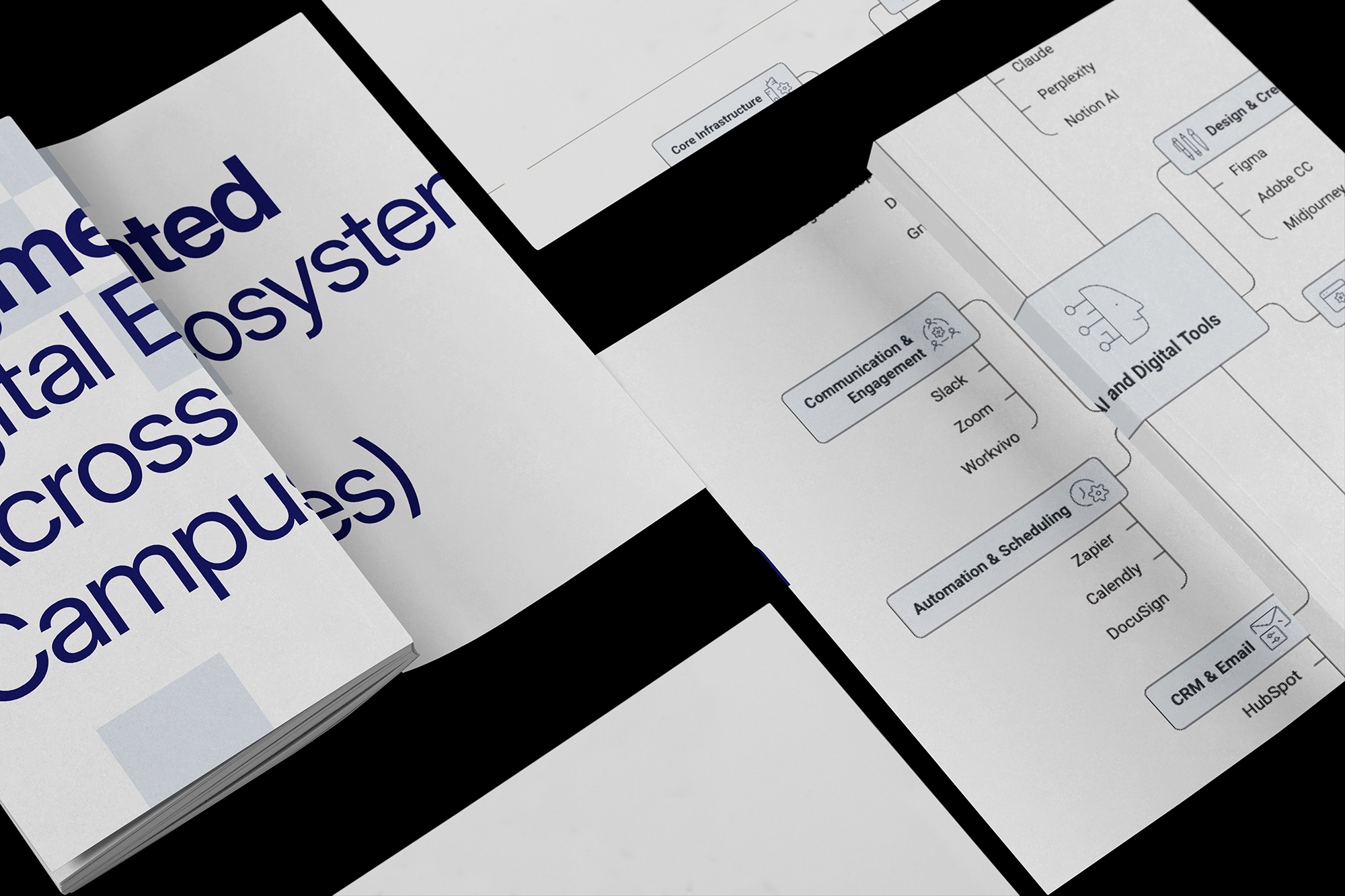
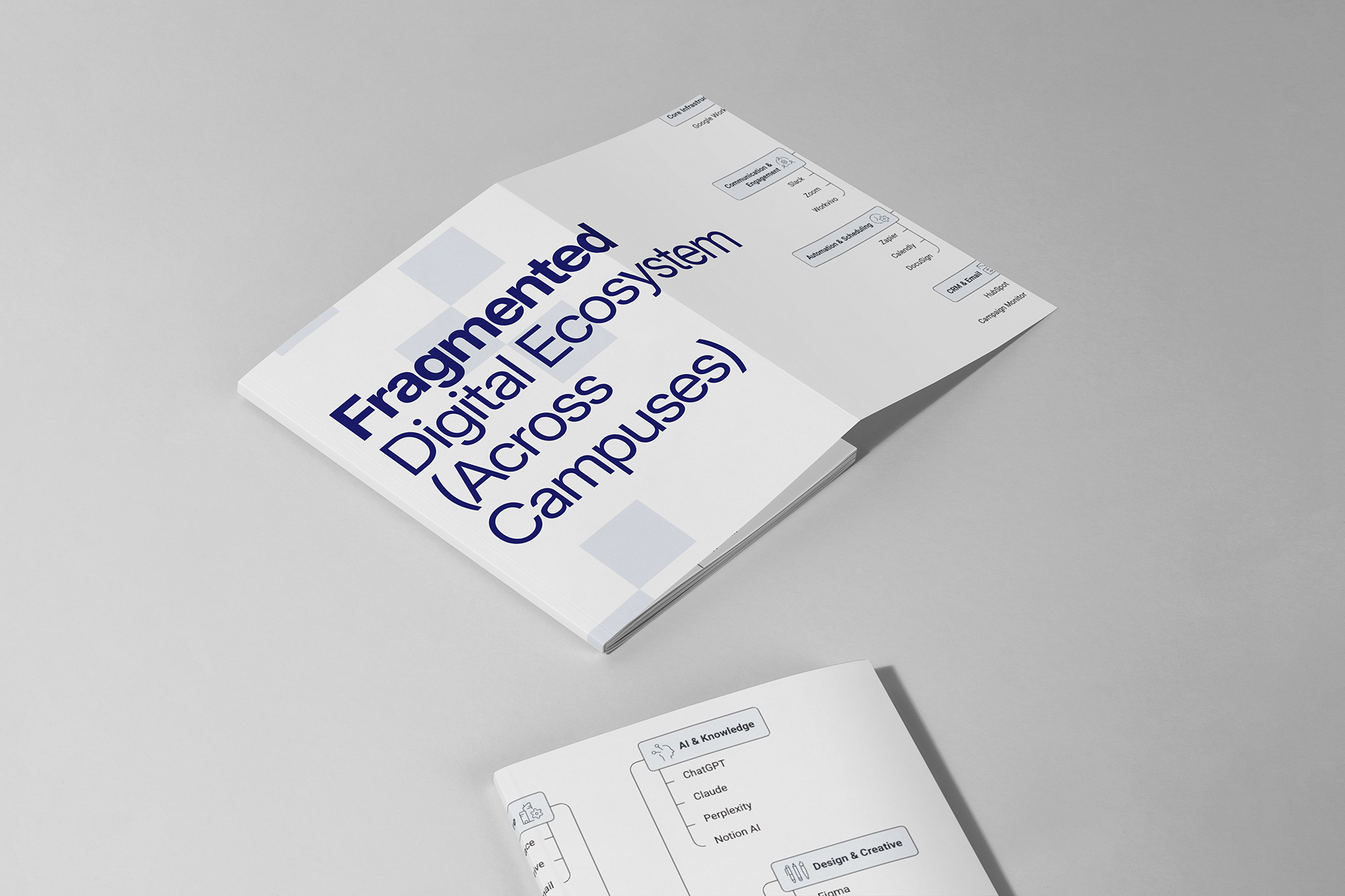
Current state. The fragmented digital ecosystem mapped across all campuses — twelve input sources, three dependency chains, the places where the institution is exposed to single-person risk.
Strategic objectives. What a unified architecture has to do for the network. Not a vendor list. A set of capabilities the institution needs to hold.
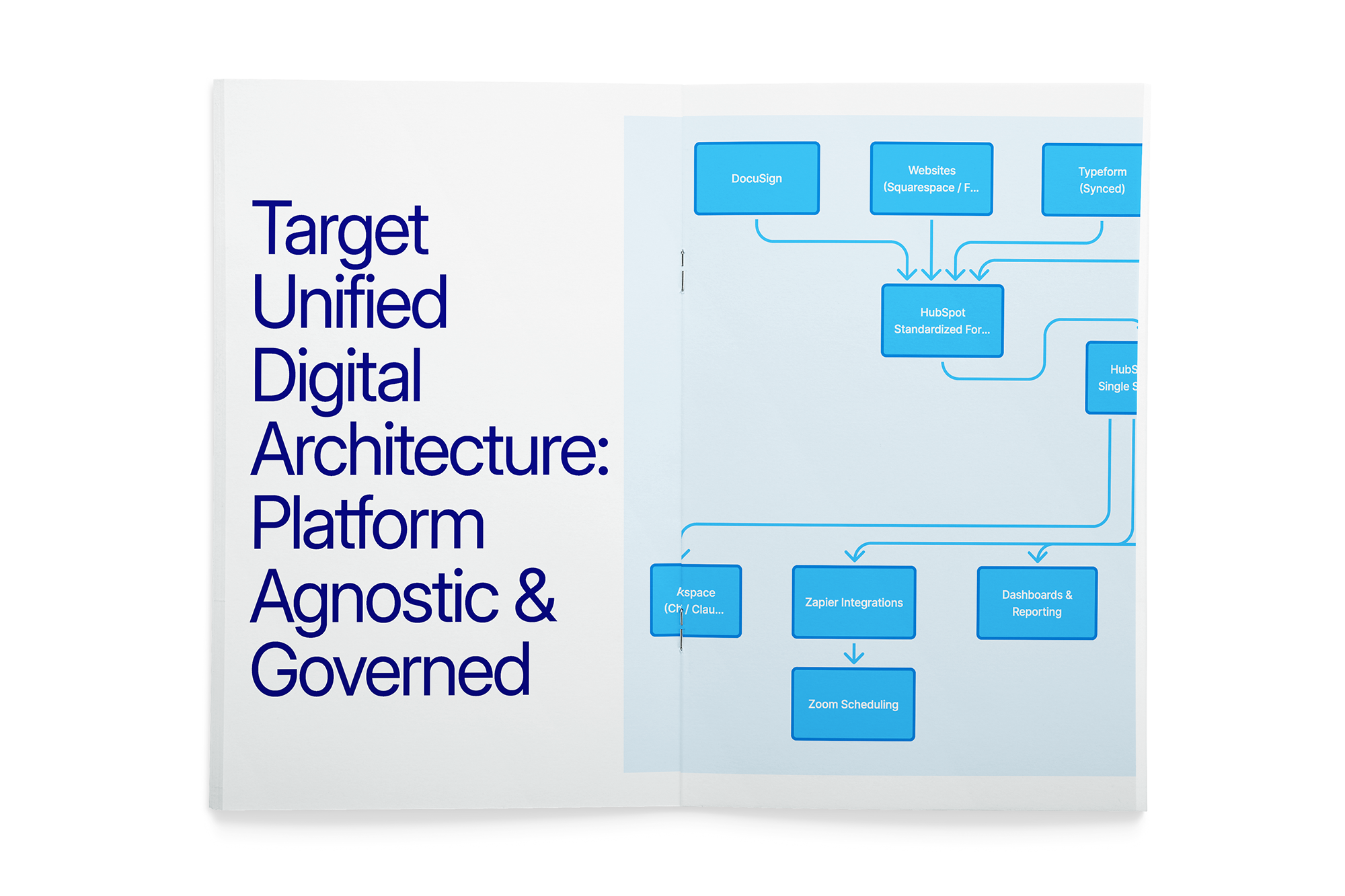
Target architecture. A three-layer model. Core infrastructure (Google Workspace, HubSpot CRM) as the foundation. An operational layer of integrated tools above it. A strategic AI layer governed by policy, not by individual discretion.
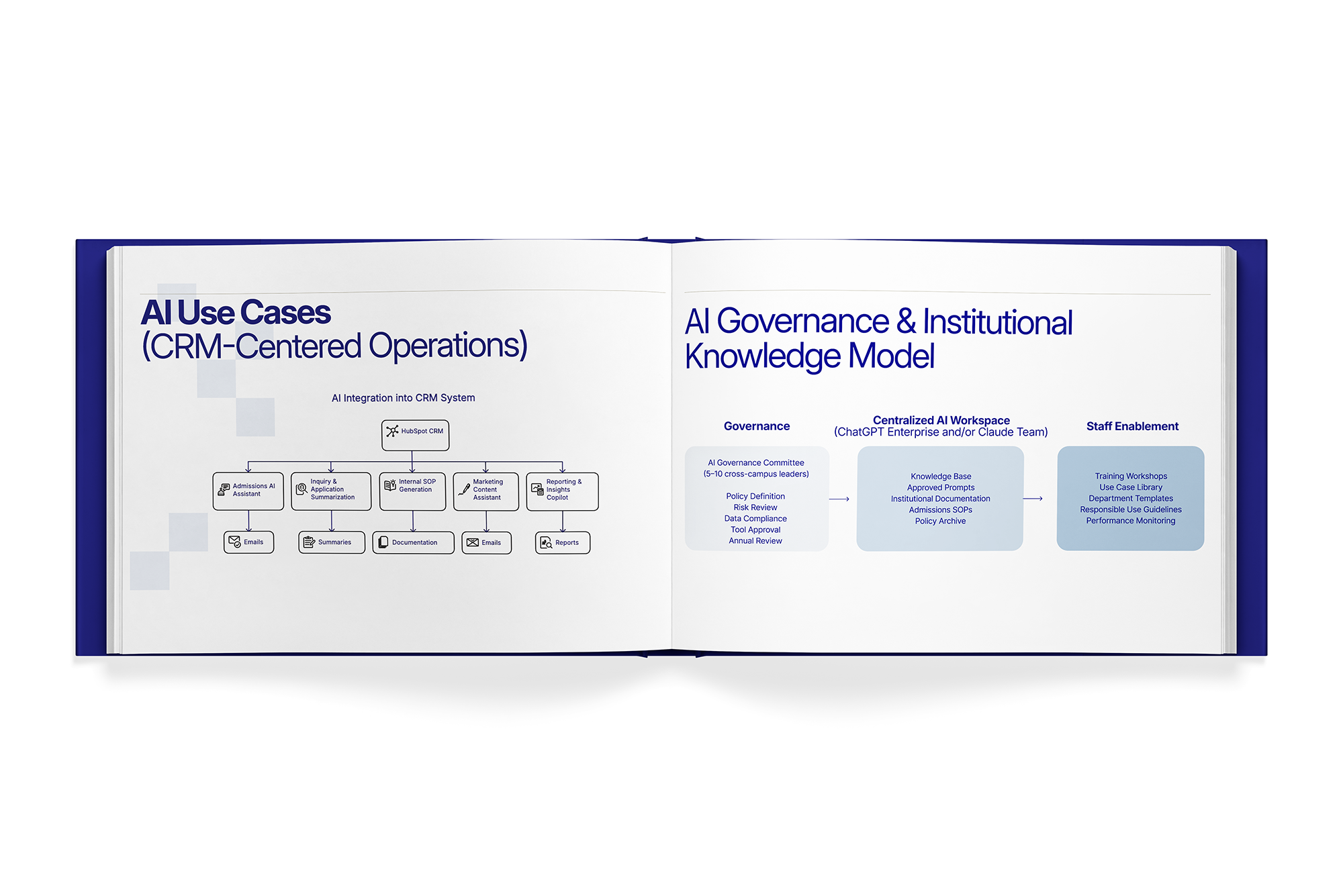
AI governance and institutional knowledge. A cross-campus committee, a centralized knowledge workspace, a staff enablement framework, a responsible-use position. Designed for this institution. Not lifted from a template.
Tool rationalization and investment. Which tools survive, which consolidate, which get cut. What the institution buys versus what it builds. The cost of doing nothing, named explicitly.
Ninety-day execution plan. Three phases — Audit and Stabilize, Centralize and Integrate, Govern and Scale. Each phase with named owners, named deliverables, named decision points.
Twelve-month roadmap. Quarter by quarter, milestone by milestone, through the first year of a unified architecture.
The document is paced as a leadership read. Diagnosis first, because the case for the work has to be made before the work can be evaluated. Architecture second, because the diagnosis demands a target. Governance and tools third, because architecture without policy is theater. Plan and roadmap last, because execution is downstream of the conditions above it being settled.
This was not a design brief. It was a systems brief — written with the same diagnostic rigor I would bring to a brand audit, applied to organizational infrastructure.
The research had three registers. The Parsons certificate gave me the AI governance literature, the academic frame for institutional AI adoption, and the prototyping practice — three AI-augmented workflow prototypes for Design and Marketing, Admissions and Enrollment, and Operations and Parent Experience were developed during the certificate and fed directly into the Blueprint. Six years inside the institution gave me the contextual map: which workflows actually run the school, which staff members carry the institutional knowledge in their heads, where the dependency chains are most exposed. Vendor research — the discipline I now run as the Vendor-Call-as-Artifact protocol below — gave me the comparative ground for evaluating real platforms against real criteria.
The Blueprint is the synthesis of those three registers. The Parsons work and the Blueprint are not separate projects. They are two registers of the same thinking — one academic, one operational. Together they form a body of work that demonstrates AI systems thinking applied at organizational scale.
-
Every other case study in this portfolio shows what I make. This one shows what I see.
Walking into a fragmented organization, mapping its systems, diagnosing its risks, designing its target architecture, and producing a leadership-grade document at investment scale — that is not a design skill. It is a strategic capability. It is the capability the next phase of this practice is built on.
The document also did something to the role I hold. It made the work I have been doing for six years legible at the level it actually operates. Brand systems, websites, editorial, social, AI workflow architecture across three campuses with brand standards for a fourth — that is institutional design. The Blueprint is the page where that work names itself.
-
Role: Strategy, systems architecture, workflow design, AI governance framework, full document design — Monica G. Karam.
Year: April 2026 – Present.
Collaborators: Academic prototype work completed as part of the Parsons AI for Creativity and Leadership certificate, December 2025. Parsons The New School.
External link: None. The Blueprint document is internal.