
03 //
PARSONS
FUTURES
01
What education measures, and who it fails when the measure is wrong.
PARSONS SCHOOL OF DESIGN · FUTURES STUDIES AND SPECULATIVE DESIGN · 2025 – 2026
-
Parsons School of Design's Futures Studies and Speculative Design certificate trains designers to work in time horizons most practice never reaches — twenty, thirty, fifty years out. Two courses. Design Futures 101, with Elliott Montgomery. Immersive Scenario Planning, with Alisha Bhagat. The brief, across both, is to find a system you believe is structurally broken, locate its leverage point, and build the speculative artifacts that make a different future legible.
The system was education. The leverage point was the same in both courses, asked at two scales: what we measure, and who that measure fails. Final grade across the certificate: 100%.
-
Schools optimize for what they are measured against.
Currently that means test scores, college placement, and institutional ranking — short-horizon metrics that say nothing about whether a generation makes the world better or worse, and nothing about the children whose intelligence does not show up on a standardized page. The argument the certificate work makes is that the metric is the leverage point. Change what a school is accountable for, and every downstream decision changes with it — curriculum, staffing, governance, who gets seen as capable.
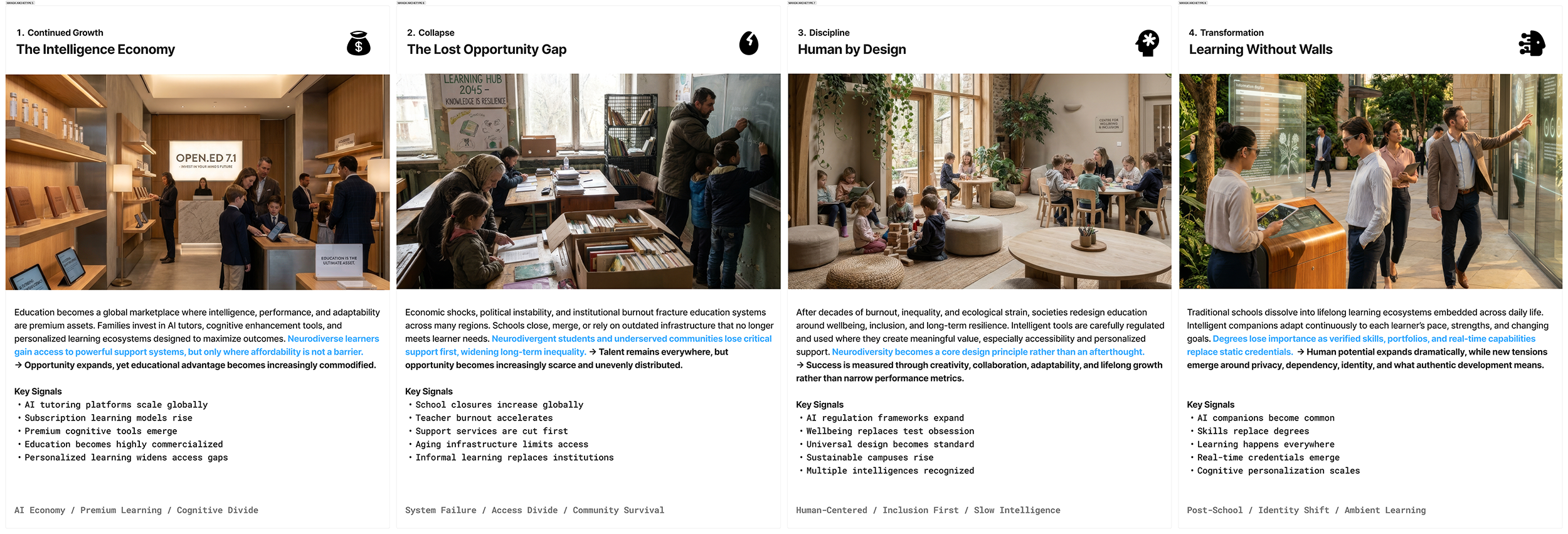
Twenty-two years of client work taught me to solve defined problems elegantly. Futures thinking taught me to sit inside uncertainty and make it productive. STEEP analysis, mapping signals across social, technological, economic, environmental, and political dimensions at once. The Futures Wheel, tracing first, second, and third-order consequences of a single change. The Manoa method, building four structurally different futures — growth, collapse, discipline, transformation — instead of one expected one. Speculative artifact-making: building things that do not exist yet in enough detail that they feel like they could. Tangible provocation, not illustration.
-
The certificate moved from system to child. Two courses, one line of inquiry.
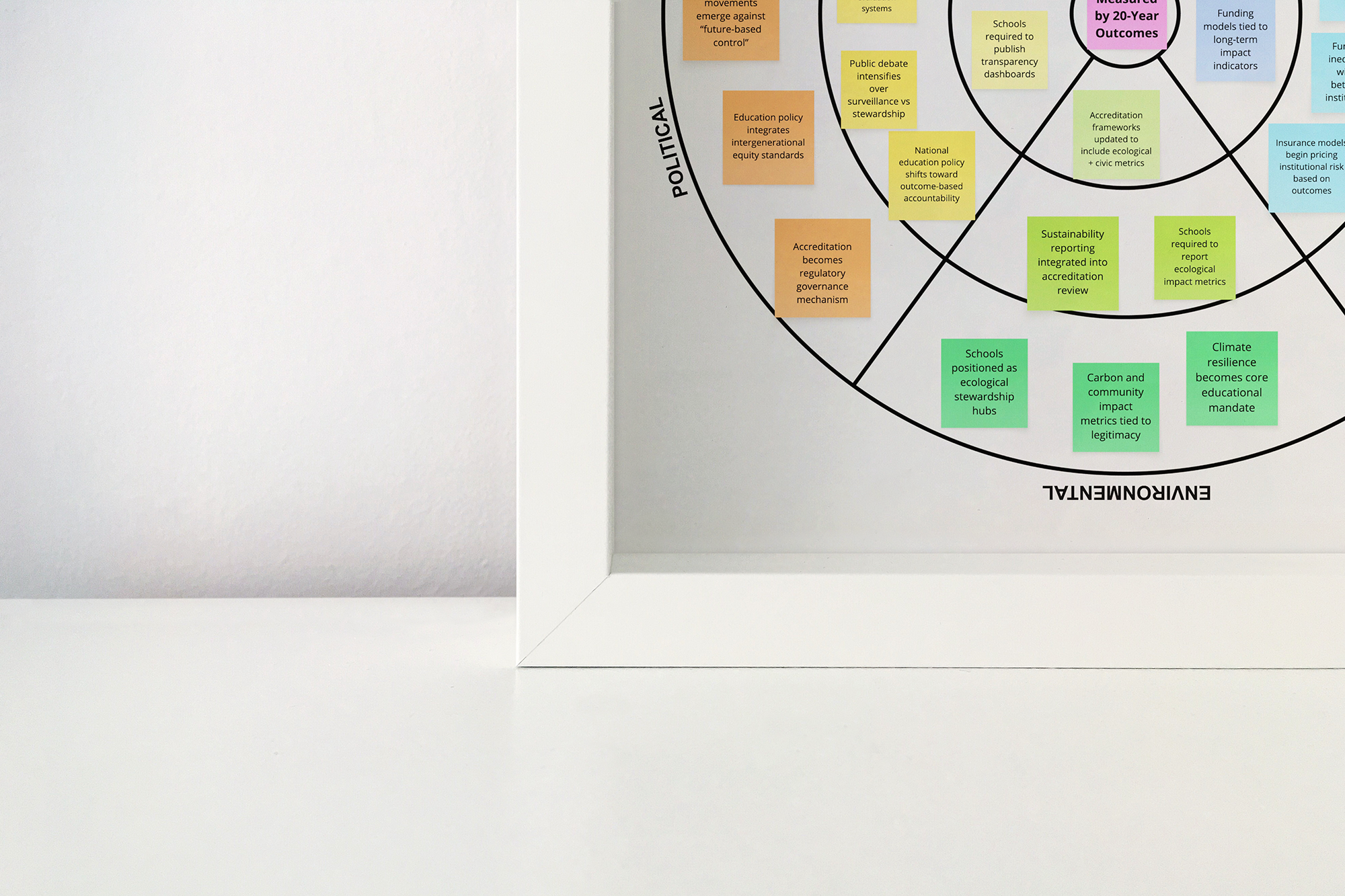
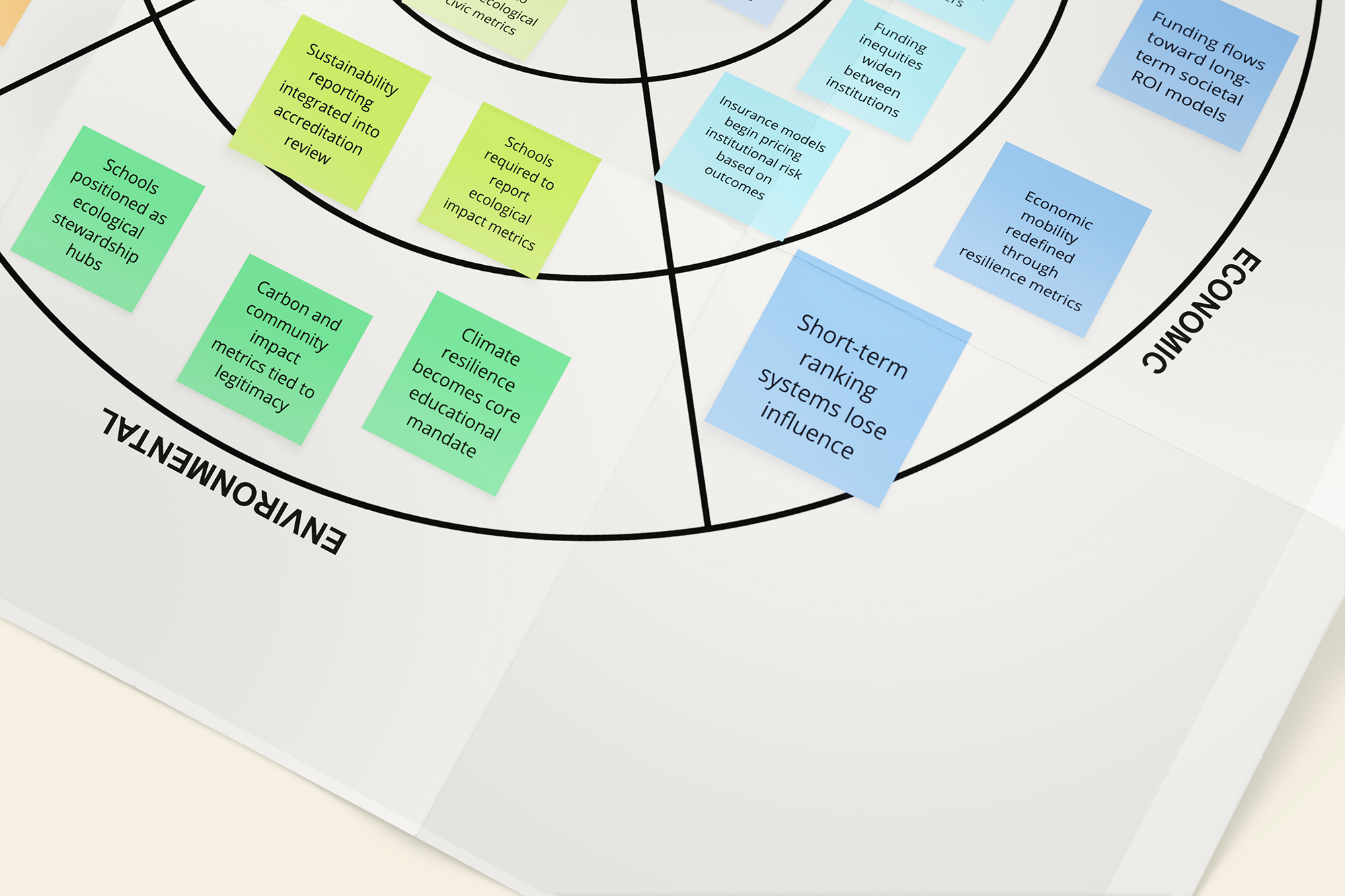
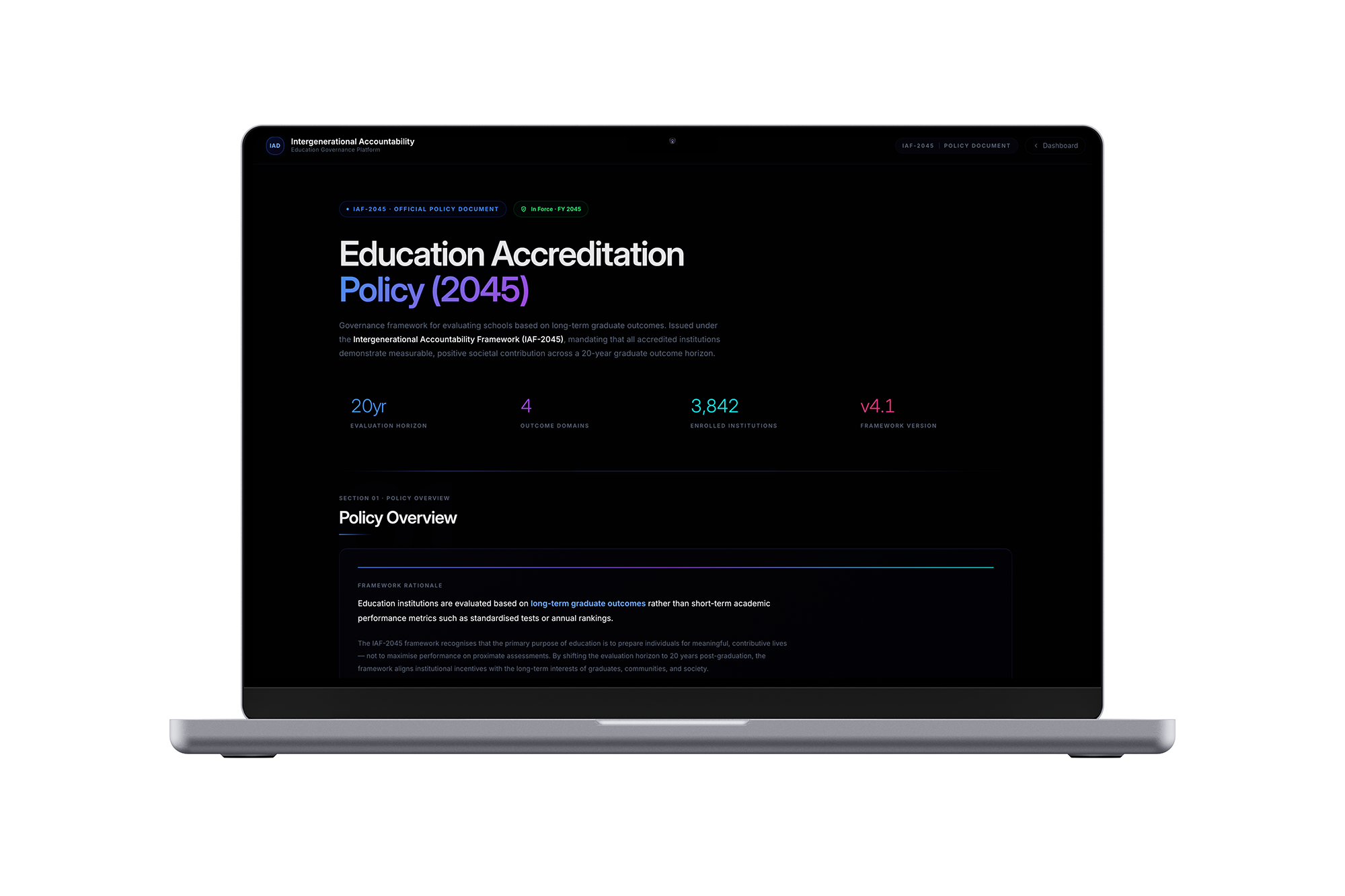
The first course built the institutional case. An accreditation system measuring schools not on graduation-day scores but on twenty-year alumni outcomes — wellbeing, civic contribution, ecological stewardship, economic mobility. A Futures Wheel mapping the systemic consequences. A 2025–2045 transition timeline making the shift plausible, not utopian. A working dashboard prototype that visualized real-time evaluation against those outcomes, and a family-facing scorecard that turned choosing a school into reading a long-term track record. The argument was structural: measure differently, and institutions behave differently.
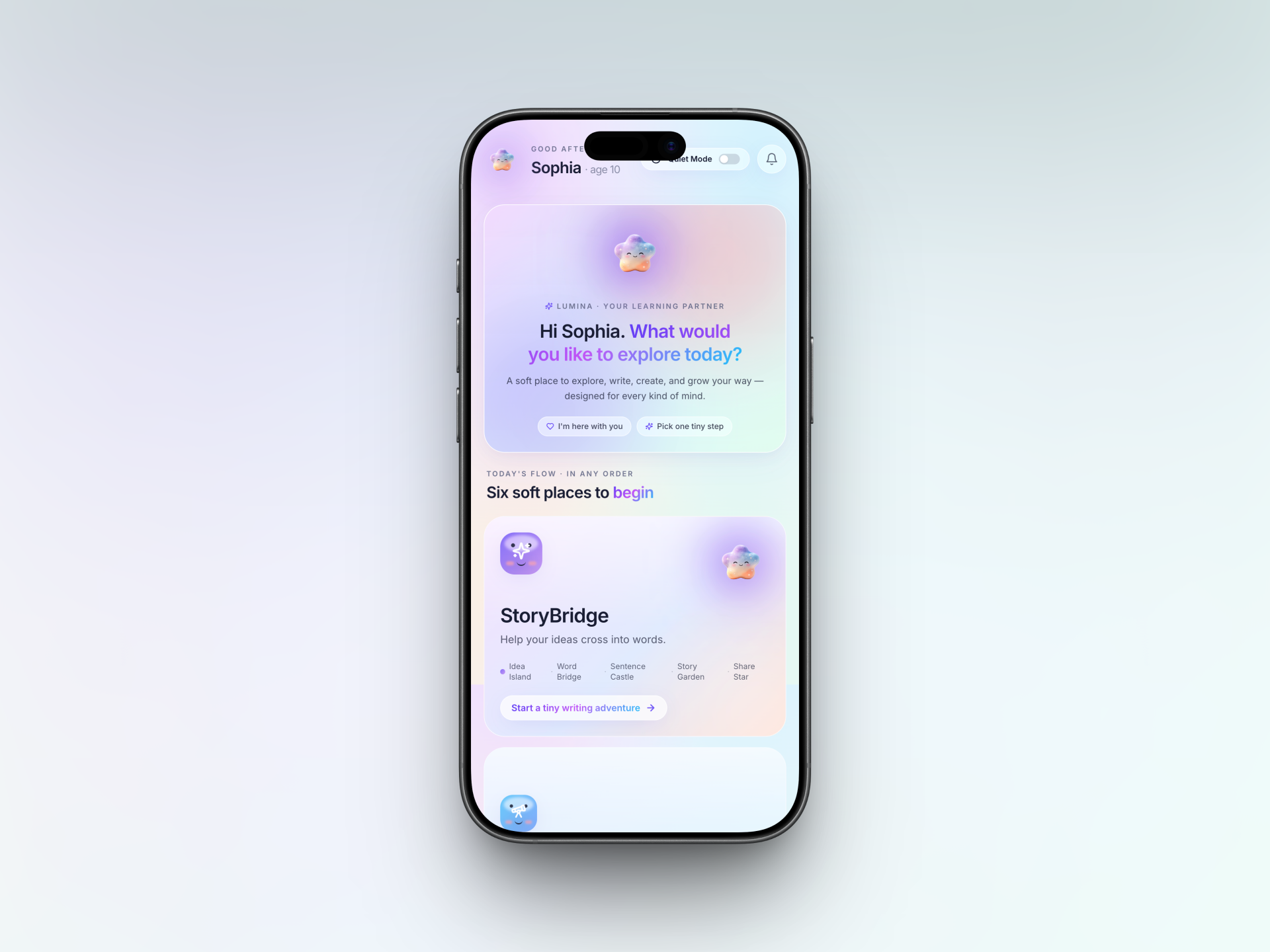
The second course made it personal. If the current system fails the child who does not fit its measure, then the test of any better future is a single learner. So the final immersion narrowed from a national accreditation model to one nine-year-old.Lumina: Your Learning Partner. A speculative AI learning companion set in 2035, designed around Sophia — a brilliant, autistic, visual, nonlinear thinker — built on the question: how might AI reshape education for neurodivergent learners, and when does support become control? Built through the Manoa method's four futures, anchored in the transformation scenario: Human by Design, a world where education is designed around cognitive difference rather than standardizing it away.
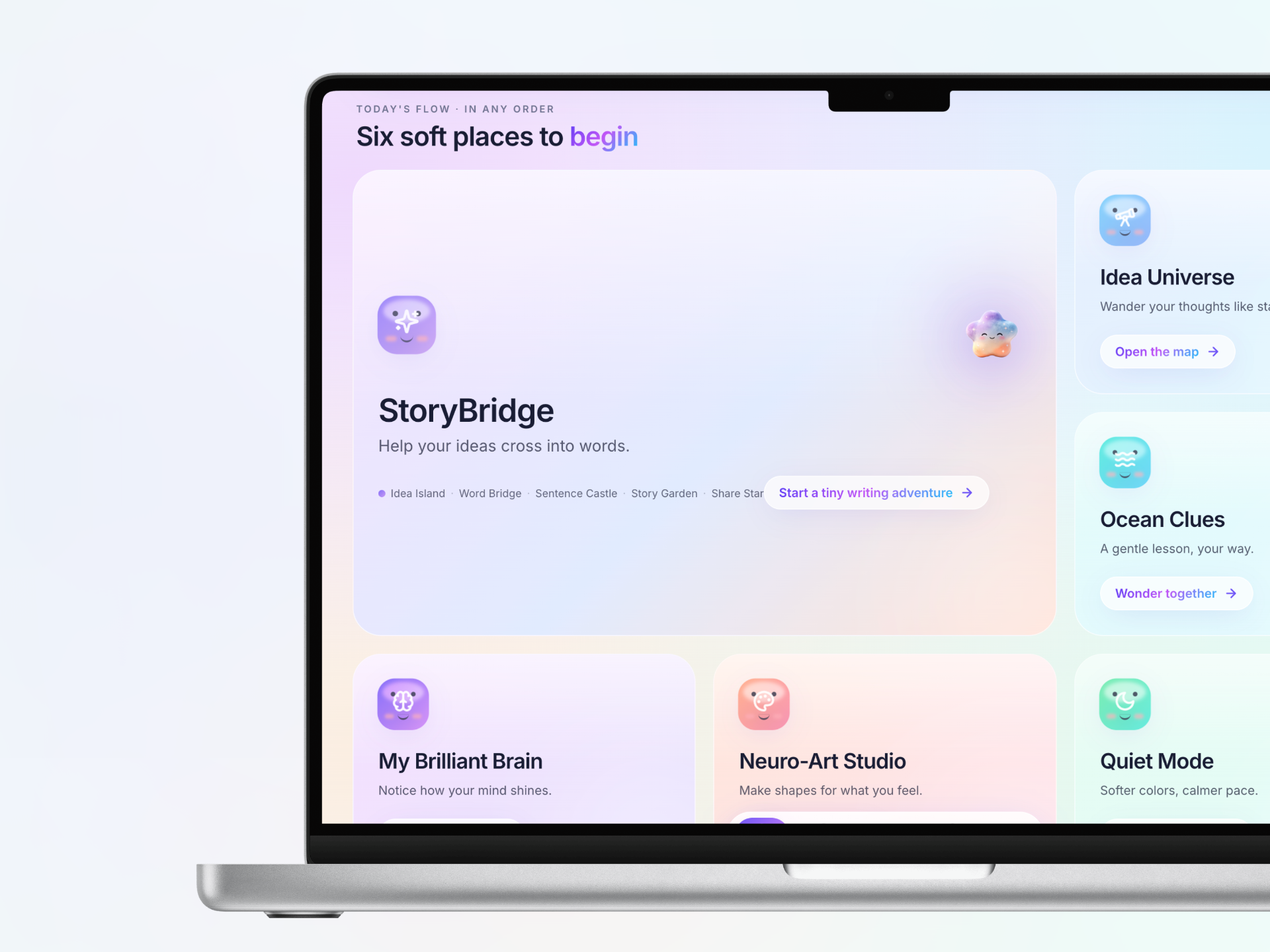
Lumina has no grades, scores, or streaks. It has an Idea Universe that turns nonlinear thinking into a navigable map. Ocean Clues, a choice-based visual lesson. StoryBridge, a writing game that moves a big idea into sentences through small visual steps — built around writing because handwriting can mask a child's actual cognitive ability. My Brilliant Brain, which explains autism through strength and self-knowledge, not deficit. And Lumina's Understanding — an AI reflection layer that shows the child what the system thinks it noticed, and lets her correct it.That last feature is the whole argument. The design holds a hopeful future and a critical one in the same hand: AI that could help a neurodivergent child feel understood, and the same AI that could label, steer, or misread her. The prototype's answer is a principle, not a reassurance — AI interprets, but the child defines. Lumina makes gentle guesses. Sophia can always correct it.
-
Five principles hold the work together, and they are the structure beneath every screen.
No grades, no pressure. Choice before correction. Visual structure over verbal overload. Regulation is part of learning, not a break from it. And the one the others answer to: AI interprets, but the child defines.
The discipline underneath is real futures method, not aesthetic. Signal clustering, STEEP categorization, scenario matrices, the Manoa archetypes — the text-heavy apparatus of foresight work, transformed into an interactive artifact a person can move through at their own pace. The framework is speculative. The need is not.
-
The certificate was completed with a 100% grade across both courses. The Course 1 dashboard and family scorecard are live prototypes. Lumina ships as a live interactive case study and a working prototype, designed across desktop, tablet, and mobile.
The frame the work built — what are we optimizing for, over what time horizon, and who does the current answer fail — has carried directly into the institutional design work at Eastwood Schools, where the same question now precedes every brief. Futures thinking stopped being a course and became the method.
A world where the child who does not fit the current mold is not failed by it. Where neurodivergence is read as differently-wired-for-contribution, not a problem to manage. The framework is speculative. The need is not.
-
Role: Futures researcher, UX strategist, speculative product designer.
Studio: Haus of Sparrow.
Year: 2025 – 2026.
Collaborators: Parsons School of Design — Futures Studies and Speculative Design certificate. Faculty: Elliott Montgomery (Design Futures 101), Alisha Bhagat (Immersive Scenario Planning).Live artifacts:
Lumina case study — lumina-case-study.lovable.app
Lumina interactive prototype — quest-learn-canvas.lovable.app
Intergenerational Accountability Dashboard — legacy-impact-dashboard.lovable.app
School Impact Scorecard App — impact-scorecard-2045.lovable.app

Live artifacts
Lumina case study
lumina-case-study.lovable.app
Lumina interactive prototype
quest-learn-canvas.lovable.app
Intergenerational Accountability Dashboard
legacy-impact-dashboard.lovable.app
PDF Deck → Download HERE
School Impact Scorecard App
impact-scorecard-2045.lovable.app
future-impact-dash.lovable.app